


A+T 500 Series Wind sensors are the toughest, most accurate and most responsive ever made
and are simple parts to upgrade to all existing B&G systems
Tough
Carbon and graphite infused composite, strong
Proven on Vendee Globe 2025 and other oceanic races
Conductive body gives improved protection against lightning/static damage
Accurate
Individually calibrated to 0.2°
Consistent zero position; replace PCB without recalibration
User adjustable counter-balance
Responsive
Ceramic bearings, corrosion resistant and better light wind performance
High aspect ratio and carbon vane – twice as fast response of nearest competitor
Available from stock as
Digital
Output at 20Hz in NMEA0183HS (38400 baud) with optional conversion to N2K compatible
Raw data, no damping in sensor
Analogue
Traditional pulses and 3 phase angle output as B&G 213
Works with all existing A+T and B&G systems with no modification of mast cable
Upgrades and spares for existing B&G sensors
All of the parts are interchangeable with B&G parts, 213, WS310, WS710, WS720, WS730 & WS740 sensors
A+T will upgrade existing carbon vertical wand to its highest performing electronics
Wind Sensors and Parts Available to Buy Online
Vertical Mast Units
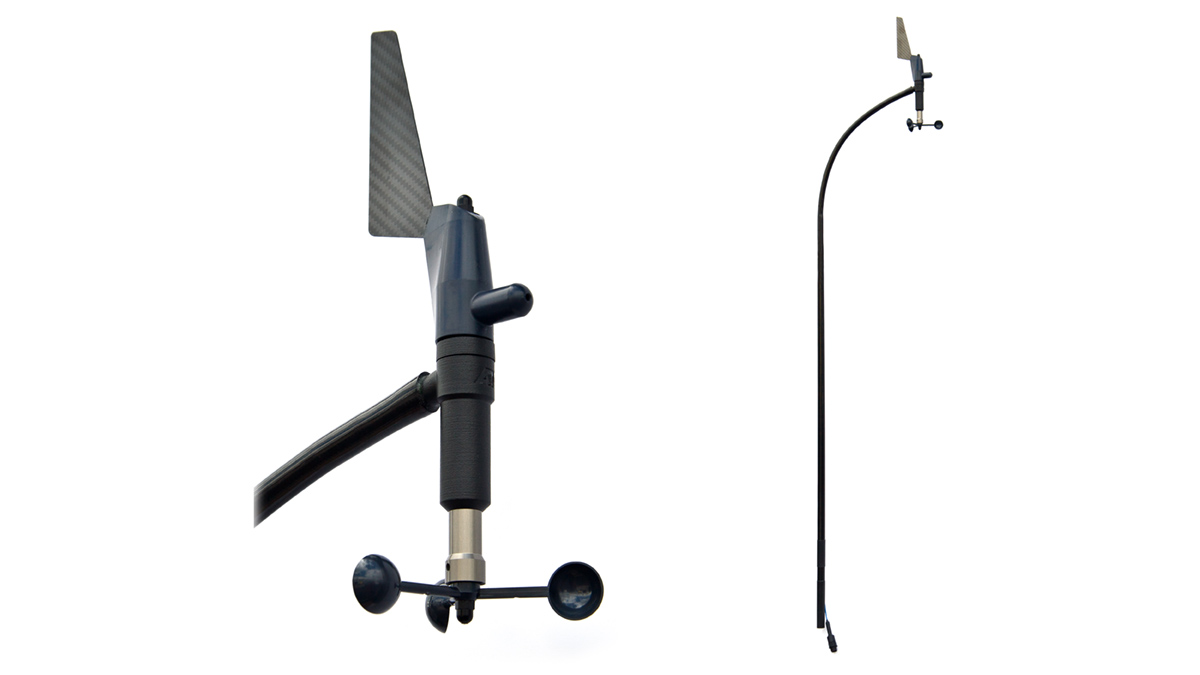

A range of vertical carbon wands to proven design from 800mm to 1,800mm.
Analogue and digital versions available.
Also mast cables available in various lengths including custom.
A wand test cable is an invaluable accessory so that wand can be tested at deck level.
Prices from GBP 2704 ex VAT and shipping
Contact the office directly to order to your specification.


-
Wind Sensor FAQs
Yes! An A+T marine wind sensor is fully compatible with the many thousands of B&G 213 wind sensors in use worldwide and with the instrument systems to which they are connected. A+T wind sensor parts are compatible with WTP3 & H5000 as well as WTP2, H3000, H2000, Hydra, ACP2 pilots including all the wind sensors for these systems (B&G WS Series, 213 wind sensors & Network).
If you have an existing B&G 213 wind sensor or are looking for B&G wind sensor parts, we offer spares and parts to repair and upgrade them, even for something as small as a B&G 213 bearing. An existing (i.e. B&G) vertical wind wand can be upgraded with the A+T 500 series wind sensor. Spares and parts are available to buy online for same-day shipping around the world. The A+T boat wind sensor uses the same mast cable and mast bracket as a B&G 213 wind sensor for a quick and easy upgrade.
We also offer a complete replacement product for a B&G 213 type wind sensor, in both horizontal and vertical versions.
An initial calibration for your sensor for wind speed can be achieved by fast motoring dead upwind in very light winds and adjusting the MHU offset to achieve zero AWA. It is useful to use an average over approx. 30s to finalise this.
To refine this calibration, check AWA is the same upwind tack to tack with well-mixed wind and the same trim and boat speed on each tack. Once the MHU offset is fine-tuned, TWA should also be the same tack to tack.
Once completed in good conditions, the MHU offset should NOT be adjusted unless the sailing wind sensor or mast has been removed and reinstalled.
One way to improve the accuracy of your wind sensor/marine wind meter is to upgrade the unit to the A+T 500 series wind sensor, which has the highest response and accuracy of any available wind sensor, because:
- It has a high aspect ratio, and the area of the vane and counterbalance have been designed as close to the axis as possible to enable the smallest moment of inertia.
- The unit has been made as light as possible with a carbon wind vane which again reduces the moment of inertia and gives a faster response. It is 30% lighter than legacy units.
- The height of the vane allows as much as possible to be kept in clear, undisturbed air, thus improving the accuracy and repeatability – each unit is calibrated to 0.2° accuracy.
- It has fully ceramic bearings giving better performance at low wind speeds and corrosion resistance.
The conducting graphite infused body reduces chances of damage due to static or lightning.
It has all the advantages of digital microprocessor sensing with the resolution and response of analogue output – making it compatible with all existing systems.
This video shows the difference in accuracy between A+T and B&G wind sensors.
If you want to retain your current system, you can repair and upgrade the wind sensor components of your existing B&G wind sensor or you can send it to A+T for servicing. All parts and wind sensor spares are available to buy online for same-day shipping around the world.
In most cases, the obvious casualty is the mast wand and electronics itself, which can both be replaced. At the same time, it is wise to replace the mast cable, which will almost certainly be badly damaged at the mast-head connector.
Harder to pin down are more subtle areas of damage that can occur to the processor, particularly wind board and other interfacing functions. It is also worth looking out for other apparently unrelated interfacing breakdowns on links to other marine and computer equipment.
If suspect, you can send your wind sensor to us to test, service and repair complete processors.
If you would like to troubleshoot why your wind sensor has stopped working, you can watch a how-to video here. If you are fixing it yourself, we stock wind sensor parts and spares which are available to buy online for same day shipping around the world.
If you’re looking for a replacement wind speed sensor, we would recommend the new AT500 series wind sensor, which has been designed with a conducting graphite infused body to reduce chances of damage due to static/lightning.
If you have had a lightning strike then the chances are that there is damage to more instruments and systems on your boat, please call our team for 24/7 technical support. We repair and advise on processors, displays, sensors, and cabling.
The A+T 500 series wind sensor anemometer is compatible with all B&G systems, old and new. The A+T boat wind sensor uses the same mast cable and mast bracket as a B&G 213 wind sensor for a quick and easy upgrade.
Here are step-by-step instructions on how to change the printed circuit board (PCB) on your anemometers and wind sensors:
- Using an 8mm nut spinner, unscrew the top nut and remove the vane.
- There is a second nut on the B&G 213 unit with a washer underneath.
- Now the top cap comes apart - just use your hand to grip around the cap.
- The PCB inside slides out.
- The connector unplugs.
- The new A+T PCB must go into the guiding slots properly before plugging the connector on with the visible gold contacts facing away from the PCB.
- Ease the cable in whilst the PCB is in. Be careful not to push on the top because you can damage the coils which can affect the accuracy.
- Once you have changed the PCB, re-assemble the unit.
- The top screws back on in the way it came off, just finger tight. Be careful not to overtighten it because it can split.
- There is a slot in the bearing which has to line up with the lug in the skirt. If the skirt doesn’t align, there will be a gap, so you have to turn the shaft until the skirt clicks into place.
- Then fit the washer, followed by the white nut. Tighten it finger tight with the nut spinner.
- Finally fit the vane and the black dome nut
There are a few areas where the issue could lie. Please find instructions below outlining how to test each component to locate the fault:
If the wind speed cups and vane are still turning as expected, the most likely reason is failure of the printed circuit board (PCB) inside. A replacement PCB, which is compatible with B&G wind sensors, is available from A+T. If you would like to fit it yourself, watch this video.
Other problems could be a wiring issue or a problem with the instrument processor.
To test whether it is a wiring issue, follow these steps:
- Download the test diagnostic sheet from the A+T website here.
- Test the vane pointing forward, 90 degrees starboard, aft, and 90 degrees to port.
- The wind speed should measure when you spin the cups.
- With a meter, check that volts are output from the processor.
- With a meter, check that vane angle data is being sent by the wind sensor.
- You can also use the printout if you know the approximate wind angle and want to check the voltages at the mast junction box.
- If wind angle voltages are all working as expected, the fault must be in the processor.
To test whether there is a problem with the instrument processor, follow these steps:
- Simulate the wind speed pulses into the processor.
- If any of these are not working, it is either a wiring fault (for example at the mast junction box) or the PCB replacement is required.
- If all of these are working and no data is shown on the processor, then the processor is faulty.
- If an A+T processor is used, these diagnostics are all provided on the web-server.
You can send your faulty marine wind instruments to A+T for servicing and repair. We also offer spares, parts and upgraded units for same day shipping around the world.
If your wind speed cups have stopped spinning, it is most likely a faulty bearing. You can purchase a sailing wind speed bearing or wind direction bearing from our online wind shop. Alternatively, you can send your entire unit back to us for servicing, repair or upgrade.
If you would like advice from our 24/7 technical support team, please call +44 01590 718182.
There are a few areas where the issue could lie. Please follow the steps outlined in the section above, titled: My wind sensor isn’t working. How can I fix it?
You can also send your faulty marine wind instruments to A+T for servicing and repair. We offer spares, parts and upgraded units for same day shipping around the world.
If your marine anemometers wand has broken, it will have to be replaced. We can replace this for you. Please call us at +44 01590 718182 or email us at info@aandtinstruments.com to arrange. Here is more information on sending in your items for repair.
Yes! If you’re looking for wind instruments for boats, you can buy sailing wind sensors, parts and spares on our online store.
For any other parts, complete units or technical support and advice please call us at +44 01590 718182 or email us at info@aandtinstruments.com.
Yes! If you want components that are compatible with all types of wind sensors, check out the A+T online store.
If you want a complete sailing wind sensor, the A+T 500 series wind sensor can use the same B&G mast cable and mast bracket for a quick and easy upgrade. It’s also compatible with existing B&G instrument systems.
If you want to upgrade parts of your sensor, such as, a carbon wand wind sensor part or ceramic bearing wind sensor part, we offer spares and parts to upgrade a B&G 213 wind sensor/ masthead unit.
Yes the whole range of A+T wind sensors is available with a digital output. This is NMEA0183HS so 38,400baud at 20Hz. This is faster than all other units including B&G and importantly has no damping. The B&G digital wands have several seconds of damping built into the sensor.
A converter is also available to provide N2K compatible output.
A digital A+T pcb into an existing B&G 213 or A+T 500 wind sensor will convert this to digital also.